You’ve published blog content. You rank somewhere on page 2. Then you notice something unsettling: the result above, position #1, isn’t a blue link anymore. It’s a big AI-generated answer box that answers the question before anyone clicks. That’s Google AI Overviews-and if you’re wondering how to rank in Google AI Overview results, it starts long before you hit publish.
If your content isn’t inside that box, you’re invisible for a growing share of the searches your potential customers run every day.
Here’s what most guides won’t say upfront: getting cited in Google AI Overviews has almost nothing to do with ranking #1. Research across 15,000+ results shows 47% of cited pages sit outside the top 5 organically. The AI selects for clarity and trust-not position. For early-stage SaaS sites that can’t yet outmuscle established domains, that’s genuinely good news- and it makes investing in domain authority one of the highest-leverage things you can do right now.
This guide breaks down exactly how to optimize content for AI Overviews -based on what the data actually shows, not guesswork.
What Is Google AI Overviews?
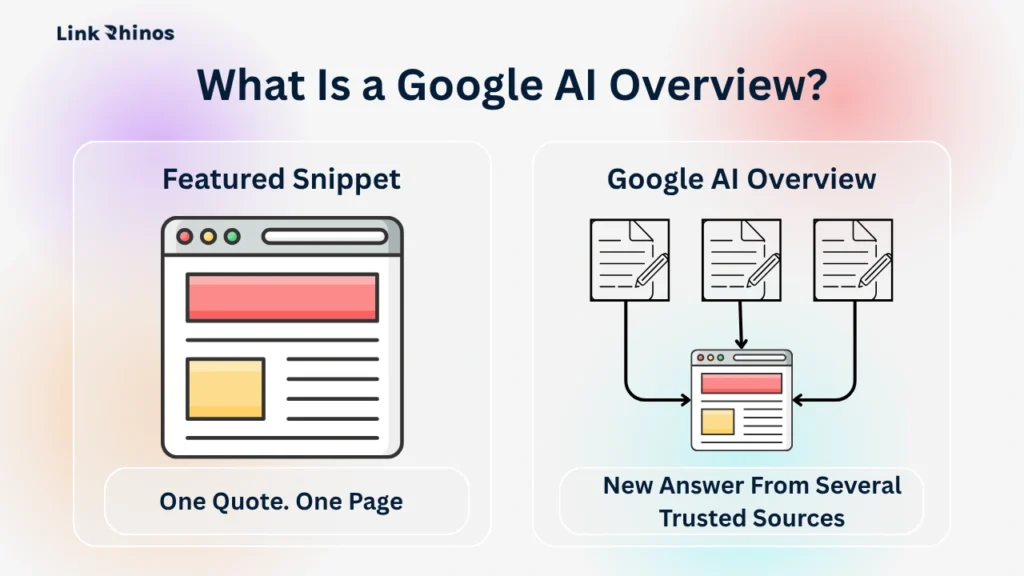
So what is Google AI Overviews, exactly? It’s an AI-generated answer that appears above the regular search results when you search for information. Understanding how Google AI Overview works is straightforward: it scans multiple trusted sources, synthesizes them into a clear answer, and shows you exactly where each piece of information came from.
Unlike a featured snippet- which grabs one quote from one page- the AI pulls from multiple trusted sources, combines them into one clear answer, and shows you exactly where it got each piece of information.
You’re not fighting for one spot. You’re trying to be one of the few trusted sources Google cites. For SaaS companies, this is a huge opportunity. Your potential customers are already typing questions like “how do I reduce customer loss in a B2B SaaS product” or “what is a good CAC: LTV ratio”- and those are exactly the questions your blog should be answering.
Pages that appear in these AI answer boxes earn an average of 35% more organic clicks than competitors who don’t, according to Seer Interactive’s 2025 study. For a SaaS blog still building authority, that’s the fastest traffic shortcut available right now.
How Does Google AI Overview Work?
Google AI Overview works by scanning multiple high-quality pages across the web and pulling the most relevant, clearly structured answers into a single summary. It doesn’t just pick the #1 ranked page – it looks for content that is complete, trustworthy, and easy to extract.
When you search a question, Google’s AI evaluates pages based on three things: how directly they answer the query, how well-structured the content is, and how credible the source appears based on E-E-A-T signals like backlinks, author credibility, and cited sources. The result is a summarised answer at the top of the page with references to the sources it pulled from.
The key takeaway? Google AI Overview works in your favour when your content is clear, specific, and structured – not just when it ranks high.
The 4 Things That Help Google Pick You as a Source
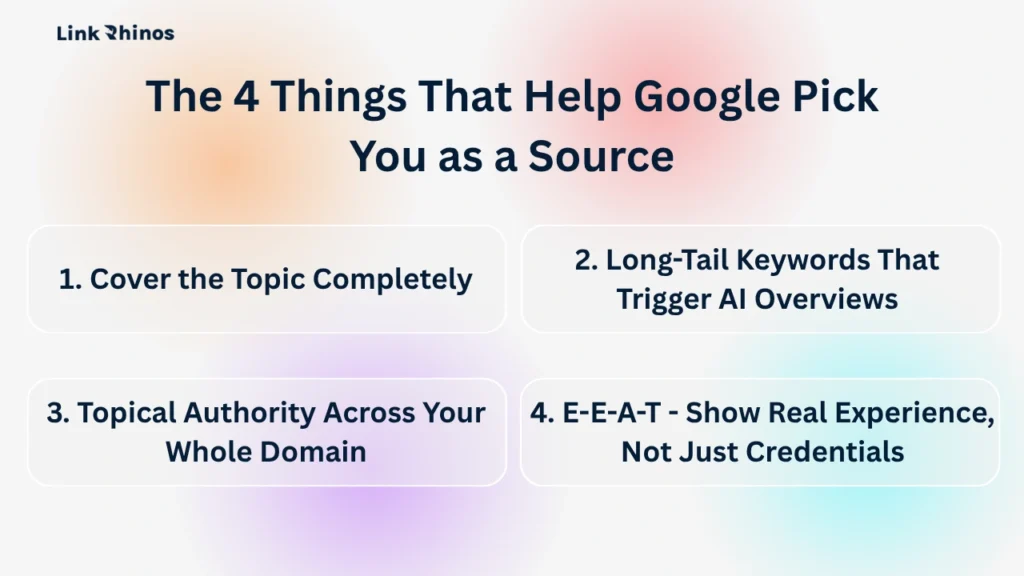
If you want to know how to rank in Google AI Overview, these are the 4 factors that actually determine whether Google picks you as a source:
1. Cover the Topic Completely
This is the biggest factor that determines if you get cited- research shows a strong 0.87 correlation. It simply means your content needs to be a complete, standalone answer- something Google’s AI can pick up and drop straight into its summary without it feeling cut off or incomplete.
If your paragraph opens with “As mentioned above…” or references an earlier section, it can’t be extracted cleanly. Instead, state your point in sentence one, define terms inline, and avoid pronouns that reference earlier context.
The fix: Write answer blocks of 130-170 words. Front-load the core point. Each H2 section should make sense in isolation, as if a reader landed directly on it- which is also the foundation of writing content that earns attention from other sites and publishers who might link to you.
2. Long-Tail Keywords that Trigger AI Overviews
Queries with 7+ words are 61.9% more likely to trigger one of these AI summaries than short-tail terms. The AI is built for specific, conversational questions- not broad head terms like “SaaS SEO” or “link building.”
The fix: Use Google’s “People Also Ask” boxes and autocomplete to find long-tail variants of your core topics. Turn each one into an H2 or H3 heading, then answer it in 60-80 words directly below. This is the fastest structural change you can make today.
3. Topical Authority Across your Whole Domain
One strong post is not enough. Google evaluates whether your domain consistently covers a topic from multiple angles- not just whether one article answers a query well.
If you publish just one post about SaaS customer loss and nothing else on the topic, Google has no reason to see your site as an expert on retention. But if you publish posts on customer loss, onboarding, cohort analysis, NPS benchmarks, and product-led growth- and link them all to each other- your site starts to look like a go-to source on the subject.
Topical authority, reinforced by quality backlinks from relevant domains, is what gives the AI the confidence to cite you over a more generic competitor. Backlinks are still a direct proxy for trustworthiness- a post that earns links from credible SaaS publications carries significantly more weight than an identical post with none.
The fix: Map out 8-10 posts around your core topic, link them all to a central pillar post and to each other-if you’re not sure where to start, our internal link structure guide walks you through the exact process step by step.
4. E-E-A-T- Show Real Experience, Not Just Credentials
If your content covers the right topics but still isn’t appearing in AI summaries, missing E-E-A-T signals are usually the reason. Google’s Helpful Content system explicitly-favours first-hand experience over general knowledge and it shows in which pages get cited.
As a SaaS founder, you have a genuine edge here. Your product data, customer stories, and hard-won observations are things a freelance writer simply can’t replicate. The problem is that most SaaS blogs don’t surface this experience on the page they read like research summaries rather than practitioner insights.
E-E-A-T also depends heavily on trust signals external to your content. Quality backlinks from respected domains, a named author with a real bio, cited sources with live links, and a visible “last updated” date all contribute. A page with strong E-E-A-T signals is far more likely to be selected for these AI citations than an equally well-written page without them.
The fix: Add a named author with a photo and bio to every post, cite real external sources with live links-because external links strengthen your E-E-A-T signals in ways internal content alone can’t- and replace generic stats with your own data where possible.
How to Optimize Content for AI Overviews
Optimizing content for AI Overviews doesn’t require a full rewrite. It’s mostly about structure and clarity. Here’s what actually moves the needle:
- Answer first – Place your core answer immediately after each H2 heading, not at the end of the section
- Write in standalone blocks – Each section should make sense on its own without referencing other parts of the post
- Target long-tail questions – Queries with 7+ words are 61.9% more likely to trigger an AI Overview
- Add FAQ schema – Structured data helps Google classify and extract your content more easily
- Build E-E-A-T signals – Named authors, cited sources, and quality backlinks all increase your chances of being cited
Small structural changes to existing posts are often enough to start appearing in AI Overview citations.
Why Your Content Might Be Getting Skipped
Now that you know what Google AI Overviews is and how it selects sources, here are the three most common reasons SaaS content still gets overlooked.
Reason #1: The Answer Is Buried
If your core point sits at the end of a long setup, the AI can’t extract it cleanly. Move your direct answer immediately after each H2 heading.
Reason #2: Your Keywords Are Too Broad
Broad, general keywords rarely show up in AI answer boxes. But specific, long-tail questions like “how to rank in AI Overviews for SaaS websites”- those get picked up consistently.
Reason #3: No FAQ Schema
Pages without structured data are harder for Google to classify and extract from. Adding FAQ schema with a plugin like Rank Math or Yoast is a 10-minute task that meaningfully increases your extraction surface.
Your 3-Step Action Plan for This Week
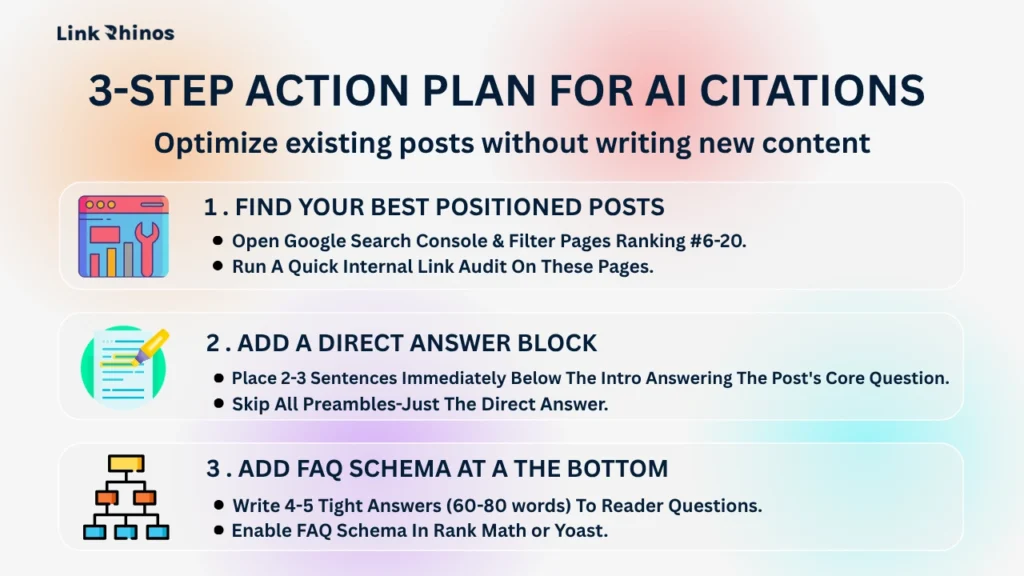
If you’ve been trying to figure out how to rank in Google AI Overview results without publishing brand new content, this is your answer. Apply these three changes to your existing posts:
Step 1: Find Your Strongest Posts
Open Google Search Console and filter pages ranking between positions 6 and 20. These already have some relevance signal- improving their structure gives the fastest return. While you’re at it, running a quick internal link audit on those same pages will show you exactly which ones are under-linked and losing authority they should be passing.
Step 2: Add a Clear, Direct Answer
Write 2-3 sentences right after your intro that directly answer the main question of your post. No warm-up lines. No “in this article, we’ll explain.” Just get straight to the answer. This is the part Google’s AI is most likely to pull and use in its summary.
Step 3: End Your Post With an FAQ Section
Write 4-5 questions your reader might still have after finishing the post and answer each one in 60-80 words. For example, if your post targets beginners, a question like ‘What is Google AI Overviews?’ or ‘How does it decide which sources to cite?’ is exactly the kind of FAQ that performs well. Then turn on the FAQ schema in Rank Math or Yoast. Each answer gives Google’s AI one more piece of content to pull into its summary and the best part? It takes almost no extra writing effort.
Done in a day. No new posts required.
How to Rank in Google AI Overview: The Bottom Line
Getting ranked in Google AI Overviews in 2026 comes down to three things:
- Build backlinks and real-world experience signals – so Google knows your content is worth referencing.
- Answer questions clearly – so Google can easily pull your content into its summary.
- Cover your topic deeply – so Google sees you as a trusted, reliable source.
Position #1 is no longer the only goal. Structure, specificity, and trust are.

Topical authority and AI Overview visibility both depend on one thing: trusted backlinks from relevant domains. LinkRhinos matches SaaS sites with vetted, niche-relevant link partners no cold outreach required →.
Frequently Asked Questions
Q1. What is Google AI Overviews, and how is it different from a featured snippet?
Google AI Overviews is an AI-generated answer box that appears at the very top of Google search results, above all organic rankings. Unlike a featured snippet which pulls one quote from one page Google AI Overviews pulls from multiple trusted sources and combines them into a single, comprehensive answer. Each cited source is clearly referenced, giving readers the option to dig deeper. It’s less about ranking #1 and more about being a trusted, well-structured source.
Q2. How to rank in Google AI Overview if my site is new or low authority?
The good news is that how to rank in Google AI Overview results isn’t purely a domain authority game. Research shows 47% of cited pages sit outside the top 5 organically. Focus on writing complete, standalone answer blocks, targeting long-tail keywords with 7+ words, and building topical authority across a cluster of related posts. Even newer SaaS sites can get cited by prioritising structure, clarity, and E-E-A-T signals over raw domain strength.
Q3. How does Google AI Overview work when selecting sources?
How Google AI Overview works comes down to a few key signals topical completeness, trustworthiness, and content structure. The AI scans pages that are well-organised, directly answer a specific question, and carry strong E-E-A-T signals like named authors, cited sources, and quality backlinks. It doesn’t just pick the highest-ranking page it picks the page whose content can be cleanly extracted and dropped into a summary without losing meaning or context.
Q4. How to optimize content for AI Overviews without rewriting everything?
The most effective way to optimize content for AI Overviews is to work on your existing posts rather than starting from scratch. Add a direct 2-3 sentence answer immediately after each H2 heading, restructure paragraphs so each one starts with the core point, add an FAQ section with schema markup, and make sure your content covers the topic from multiple angles. These structural changes alone can significantly improve your chances of being cited no new content required.