In the world of SEO, link building is important for success, but not all strategies are created equal. Understanding the difference between white hat (ethical) vs black hat (manipulative) link building is critical to safeguarding your website’s rankings, reputation, and long-term growth. Here’s a breakdown of both approaches, their risks, and why ethical practices always win.
What is White Hat Link Building?
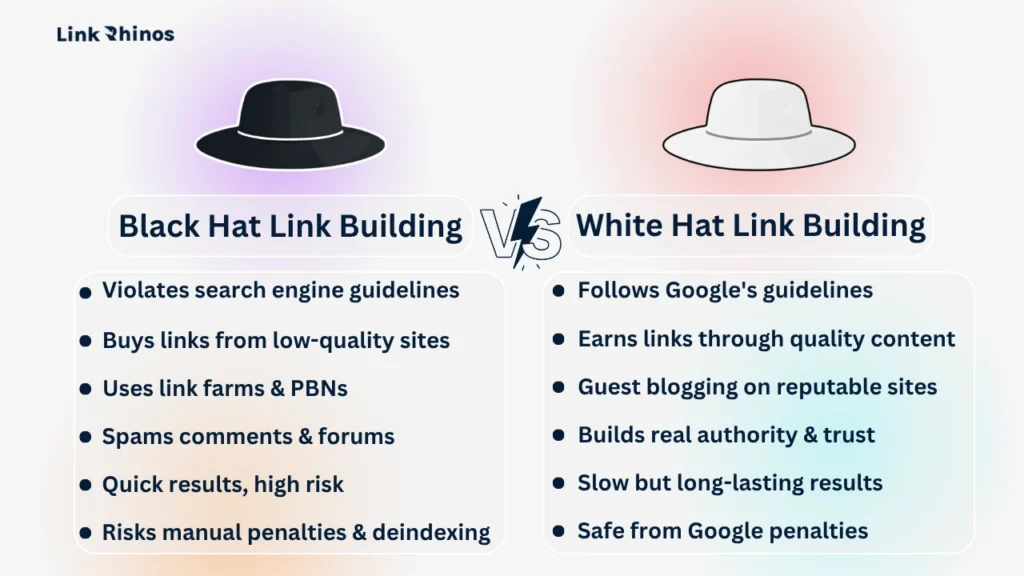
White hat link building strategies prioritize compliance with search engine guidelines and focus on earning links organically by delivering value. These methods are sustainable, user-centric, and designed to build genuine authority. Whether you are evaluating a white hat link building service or building links in-house, the principles remain the same: create real value and earn white hat backlinks that stand the test of time. This is what sets white hat linkbuilding apart from every shortcut-based approach.
White Hat Link Building Techniques:
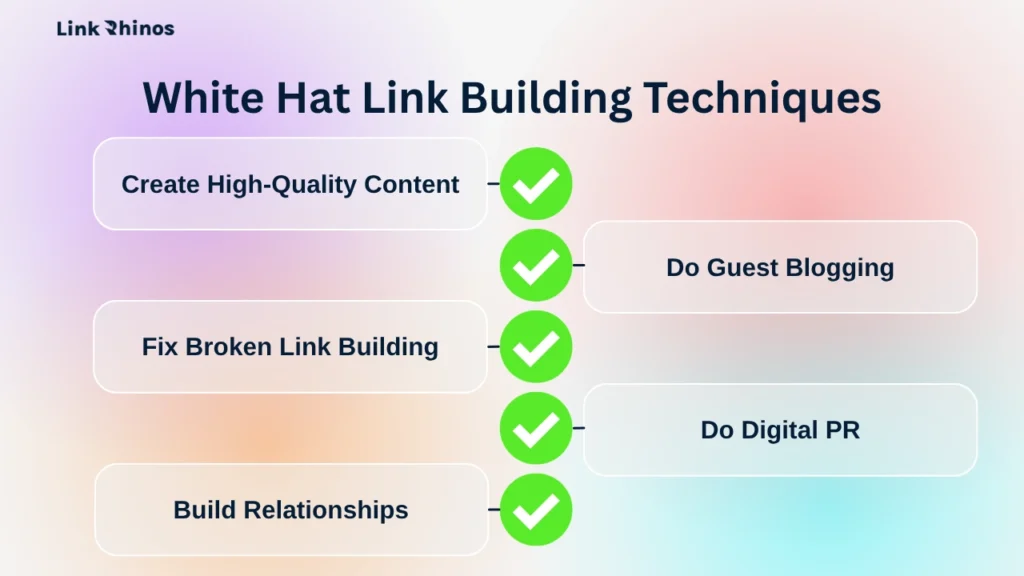
- Creating High-Quality Content: Develop in-depth guides, original research, or tools that naturally attract backlinks.
- Guest Blogging: Write for reputable sites in your niche, contributing valuable insights.
- Broken Link Building: Find broken links on relevant sites and suggest replacing them with your content.
- Digital PR: Earn media coverage through press releases, expert interviews, or data-driven stories.
- Building Relationships: Collaborate with influencers or industry leaders for co-branded content.
Benefits:
- Sustainable Growth: Links earned through value last longer and drive consistent traffic.
- Algorithm-Proof: Aligns with Google’s E-E-A-T (Experience, Expertise, Authoritativeness, Trustworthiness).
- Brand Credibility: Positions you as a trusted resource in your niche.
What is Black Hat Link Building?
Black hat link building tactics exploit loopholes in search engine algorithms to manipulate rankings quickly. These methods violate guidelines and risk severe penalties.
Black Hat SEO Link Building Techniques:
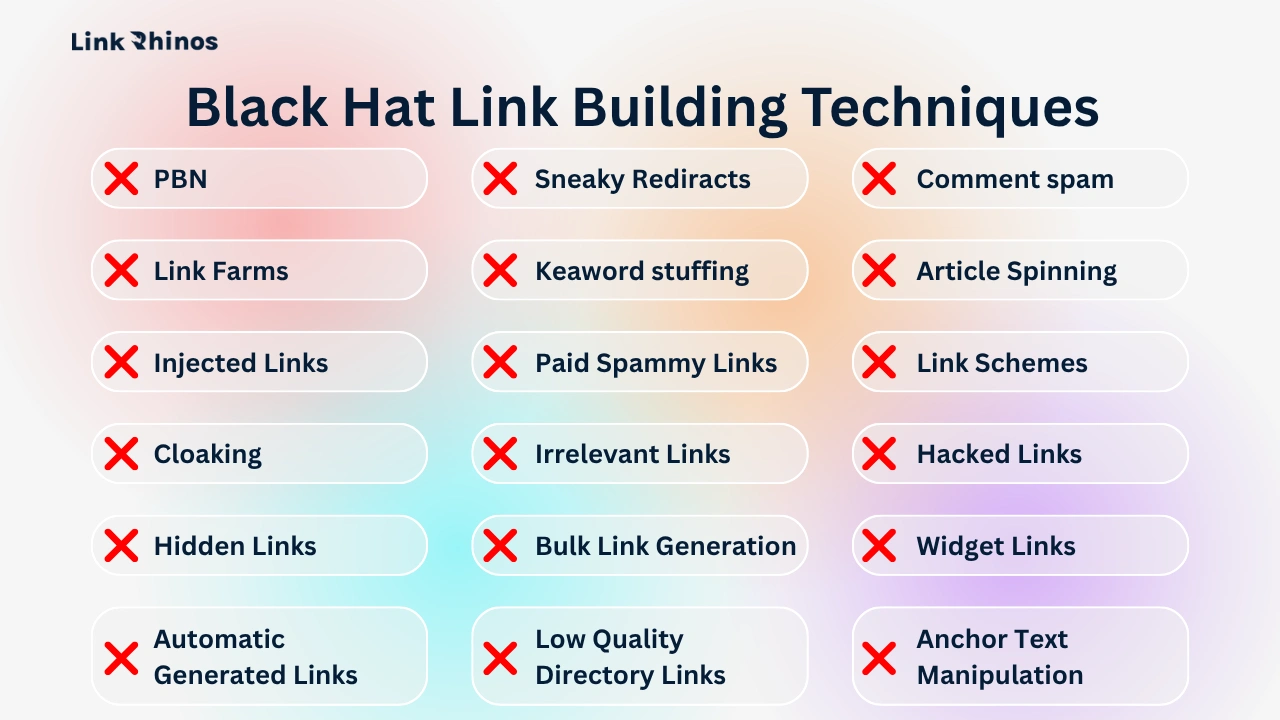
- Buying Links / Paid Spammy Links: Purchasing black hat links or paid backlinks from low-quality or irrelevant sites with no editorial value.
- Link Farms / Private Blog Networks (PBNs): Creating a network of websites solely to cross-link and inflate authority artificially.
- Comment Spam: Posting irrelevant links in blog comment sections or forum threads at scale.
- Keyword Stuffing & Anchor Text Manipulation: Overusing exact-match keywords in anchor text (e.g., “cheap insurance”) to trick ranking signals.
- Cloaking: Showing search engines different content than real users see, a direct violation of Google’s guidelines.
- Sneaky Redirects: Redirecting users or bots to a different URL than the one originally linked, often used to pass link equity deceptively.
- Article Spinning: Using software to auto-generate near-duplicate articles and scatter them across low-quality sites purely to build links.
- Injected Links: Exploiting security vulnerabilities in third-party websites to insert backlinks into their content without consent.
- Hacked Links: Gaining unauthorized access to legitimate sites and embedding links into existing pages is one of the most severe violations that Google can penalize.
- Link Schemes: Any coordinated arrangement of link exchanges, paid link rings, or reciprocal linking designed purely to manipulate PageRank.
- Hidden Links: Embedding links invisible to users (e.g., white text on a white background, zero font-size) but crawlable by search bots.
- Irrelevant Links: Placing backlinks on completely off-topic pages or directories that have no topical connection to your site.
- Bulk Link Generation / Automatic Generated Links: Using bots or automated scripts to mass-produce links across hundreds of directories, wikis, or forums simultaneously.
- Low Quality Directory Links: Submitting your site to spammy, non-curated directories purely to accumulate link count with no audience or editorial standards.
- Widget Links: Embedding keyword-rich, non-disclosed backlinks inside free widgets distributed to other websites-a tactic Google explicitly prohibits.
Risks:
- Google Penalties: Manual actions or algorithmic demotions (e.g., Google Penguin).
- Loss of Rankings: Entire domains can be deindexed. Even a concentrated burst of blackhat link building activity is enough to trigger a SpamBrain review.
- Wasted Resources: Short-term gains often lead to long-term losses.
Grey Hat: The Middle Ground
Some tactics, often called grey hat linkbuilding, straddle the line, like aggressive guest posting or paid links disguised as organic mentions. While not explicitly black hat, they carry risks if overused or misaligned with user intent.
Black Hat Forums & Tools: What to Avoid
Beyond individual tactics, entire online communities exist around black hat SEO link building. Spaces, often referred to as the best black hat forum for link building, shares methods for generating blackhat links at scale-including repurposing broken link building tools for automated spam campaigns. While these communities promise rapid results, every tactic promoted inside them violates Google’s guidelines and dramatically accelerates the risk of penalties that can take months or years to recover from.
Why White Hat Always Wins
- Survives Algorithm Updates: Google’s core updates (e.g., Helpful Content Update) reward quality. Whitehat link building is the only approach that compounds in value after every major Google rollout.
- Builds Trust: Users and search engines favor sites that prioritize value.
- Long-Term ROI: Ethical links compound over time, driving steady traffic and conversions.
How to Recover from Black Hat Mistakes
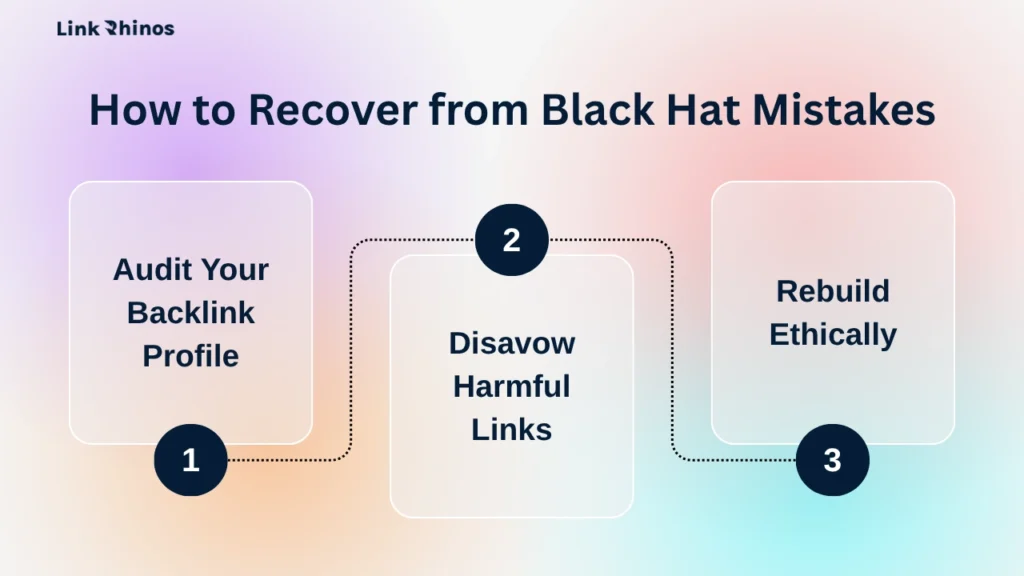
- Audit Your Backlink Profile: Use tools like Ahrefs or Google Search Console to identify toxic links.
- Disavow Harmful Links: Submit a disavow file to Google to distance yourself from spam.
- Rebuild Ethically: Shift focus to content marketing, digital PR, and relationship-driven strategies.
White Hat vs. Black Hat: A Quick Comparison
| Factor | White Hat | Black Hat |
| Compliance | Follows search engine guidelines. | Violates guidelines. |
| Speed of Results | Slower but sustainable. | Fast but risky. |
| Risk Level | Low (penalty-proof). | High (deindexing, fines). |
| User Focus | Prioritizes value for visitors. | Prioritizes search engine manipulation. |
| Example Tactics | Guest blogging, original research. | PBNs, link buying, spam comments. |
Case Study: The Cost of Black Hat
A travel blog used PBNs to boost rankings for “best tropical vacations.” Initially, they reached #1 on Google. After the 2022 Google Core Update:
- Penalty: Manual action for unnatural links.
- Result: Traffic dropped by 90%, recovery took 8+ months.
How to Stay Ethical
- Follow Google’s Webmaster Guidelines: Avoid shortcuts.
- Focus on E-E-A-T: Create content showcasing expertise and trustworthiness.
- Use Tools Like Link Rhinos: Partner with vetted, high-quality sites for safe link exchanges.
Conclusion
Black hat link building is a gamble with your website’s future. While white hat strategies require patience, they build lasting authority, trust, and traffic. In an era where search engines prioritize user experience, black hat linkbuilding simply is not worth the risk-ethical practices are not just smart, they are essential.

Ready to Grow Safely? Join Link Rhinos to connect with ethical partners and build links that stand the test of time.
About Link Rhinos: A platform for white hat link-building. Exchange links with verified sites, track performance, and stay penalty-free-no spam, no shortcuts.