You’ve published the content. You’ve earned a few backlinks. But rankings are stagnant – and the culprit probably isn’t what you think.
For most SaaS sites, the weak link isn’t the content itself. It’s that the content exists in isolation. Pages don’t talk to each other. Google crawls in, finds no clear path, and leaves most of your site underweighted.
The best internal linking strategy doesn’t just improve navigation – it tells Google which pages carry authority, how your topics relate, and where link equity should flow. Get this right, and your existing content starts ranking harder without writing a single new word.
The Core SEO Functions of Internal Linking
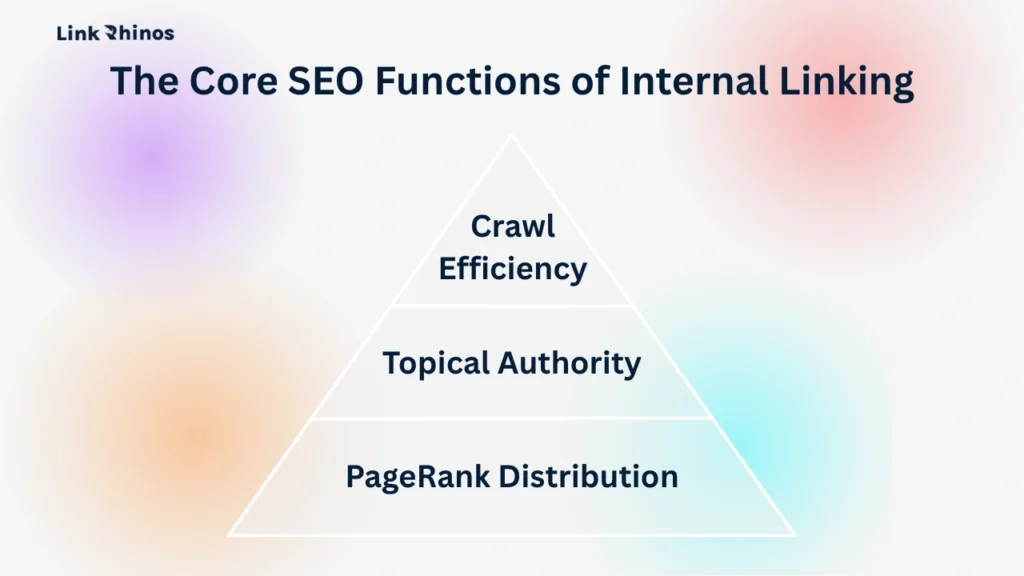
The default approach is reactive: you finish a post, paste in a “related posts” widget, and move on. That’s not a strategy – that’s decoration. Effective linking in SEO is built on three core principles that most site owners skip entirely.
1. Crawl Efficiency
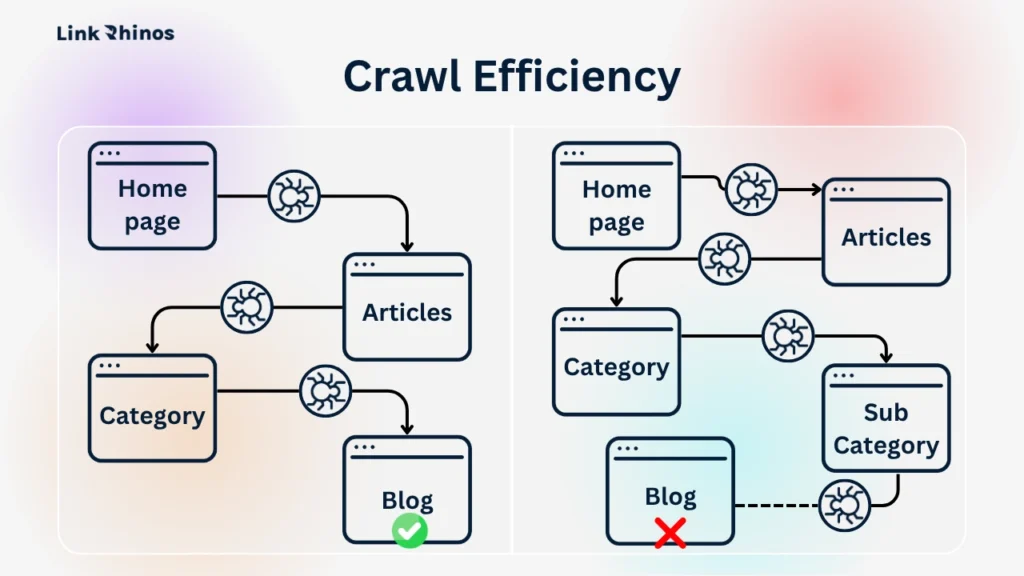
Every page on your site should be reachable within three clicks from the homepage. Pages buried deeper than that get crawled less often and indexed less reliably.
Ahrefs’ analysis of over one billion URLs found that 96.55% of pages receive zero organic traffic – and the most common trait they share is being poorly connected to the rest of the site. If Google can’t easily find a page, it won’t rank it.
2. PageRank Distribution
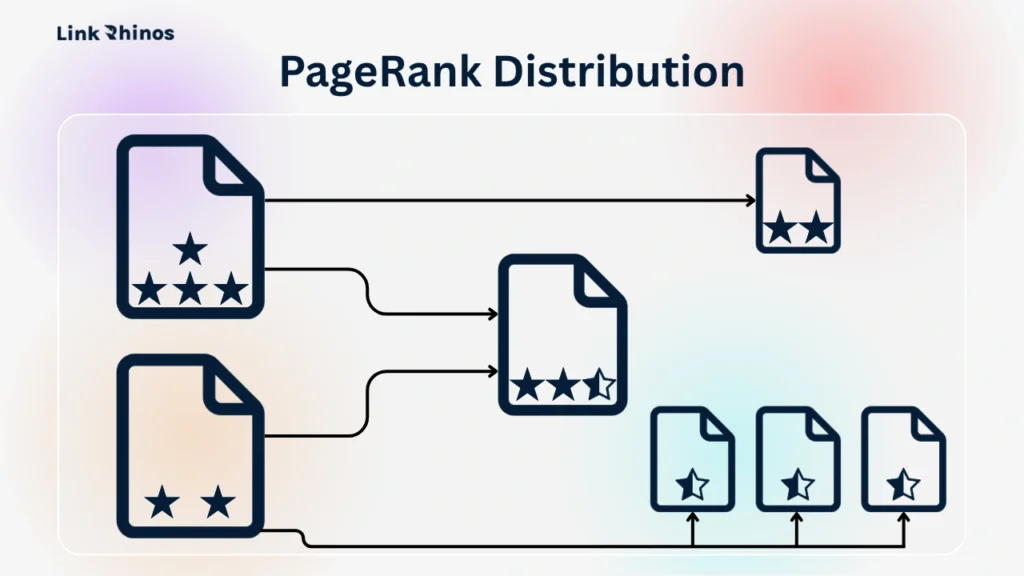
Internal links pass link equity the same way backlinks do. The pages you link to most from your strongest URLs accumulate more authority signals over time.
If your best blog posts never link to your conversion pages, those pages are starved of the signal Google uses to rank them. Your link equity is flowing in the wrong direction – and you’re losing rankings you already earned.
3. Topical Authority
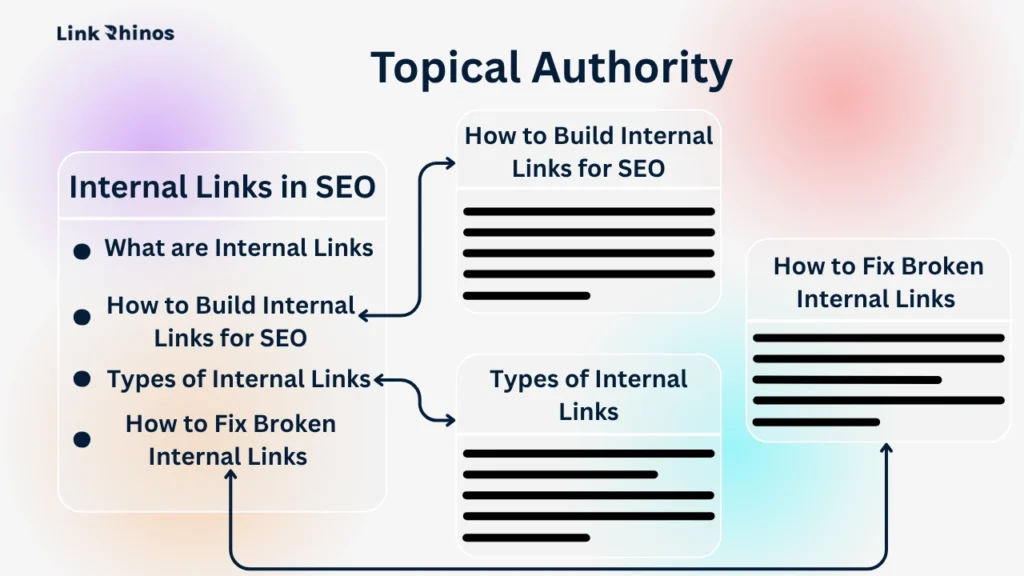
Google doesn’t just look at individual pages – it evaluates how deeply your site covers a topic overall. A group of internally linked pages that cover a topic from multiple angles sends a strong subject-matter authority signal.
This is where pillar pages and topic clusters stop being a content framework and become a real structural SEO asset. Linking in SEO isn’t just about navigation – it’s about proving to Google that your site owns a topic.
Pillar Pages and Topic Clusters
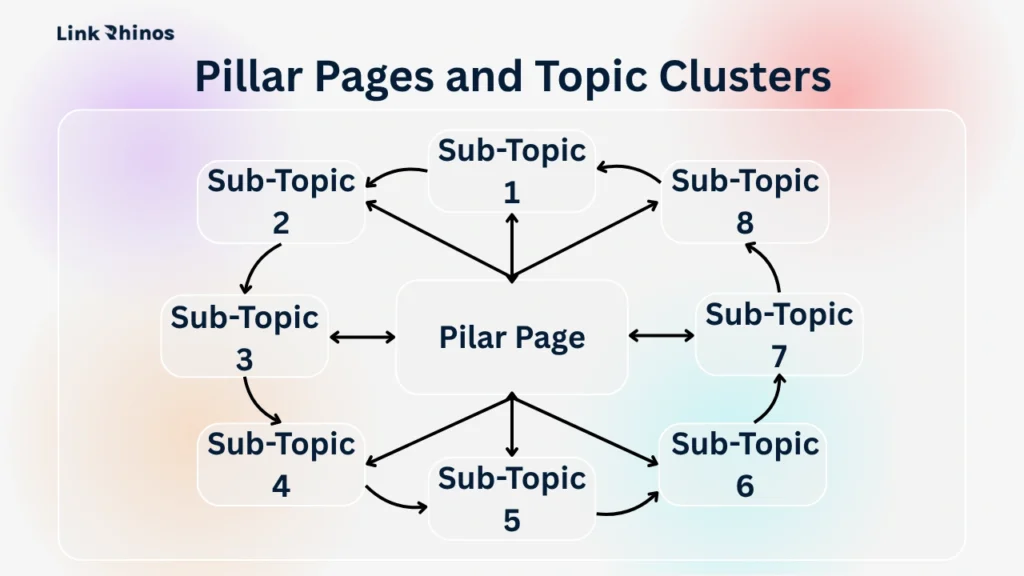
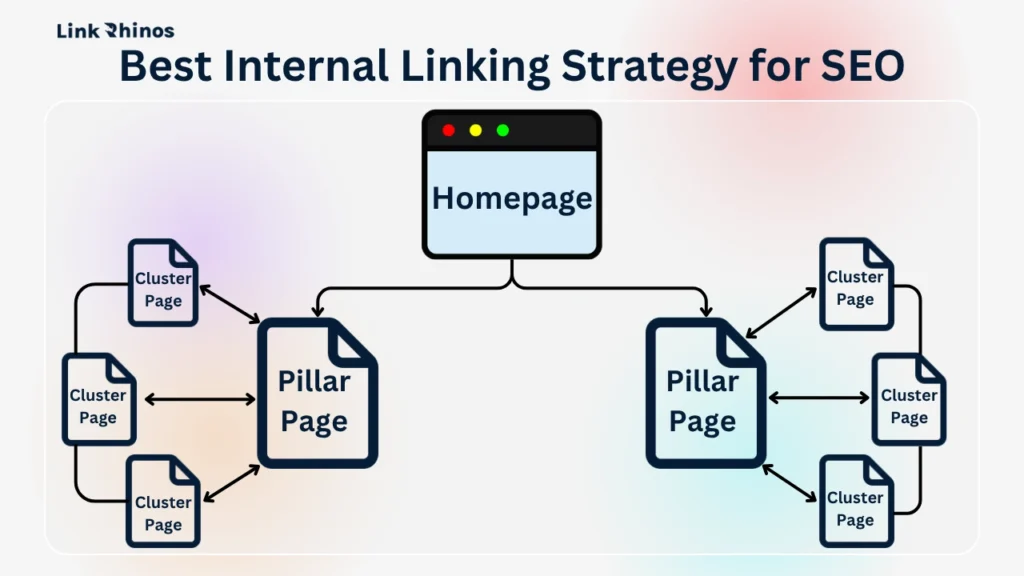
Pillar pages and topic clusters are the most effective internal linking structure for content-heavy SaaS sites – and the most underused. The idea is simple, but the results are significant.
What is a Pillar Page?
A pillar page is one comprehensive page that covers a broad topic at a high level. It doesn’t go deep on every detail – instead, it gives readers a solid overview and points them to more specific pages for each subtopic.
Think of it as the hub of a wheel. Everything related to that topic connects back to it.
What Are Topic Clusters?
Cluster pages are the supporting content around your pillar. Each one goes deep on a specific subtopic. A post about anchor text types, a post about crawl depth, a post about orphaned pages – these are all cluster pages if they live under a broader topic like “internal linking.”
Every cluster page links back to the pillar. The pillar links out to each cluster. That two-way linking structure tells Google your site has real depth on the topic.
Why This Architecture Works?
When any cluster page earns an external backlink, that link equity flows back to the pillar through the internal link. The pillar then redistributes it across the entire cluster. Every piece of content in the group gets stronger when any single piece earns a link.
HubSpot restructured its blog around pillar pages and topic clusters and reported a 55% increase in organic traffic across the restructured content. Same posts – different architecture.
For most SaaS founders, the content already exists. The fix is connecting it into a coherent structure – not publishing more.
Intent-Based Internal Linking: TOFU, MOFU & BOFU
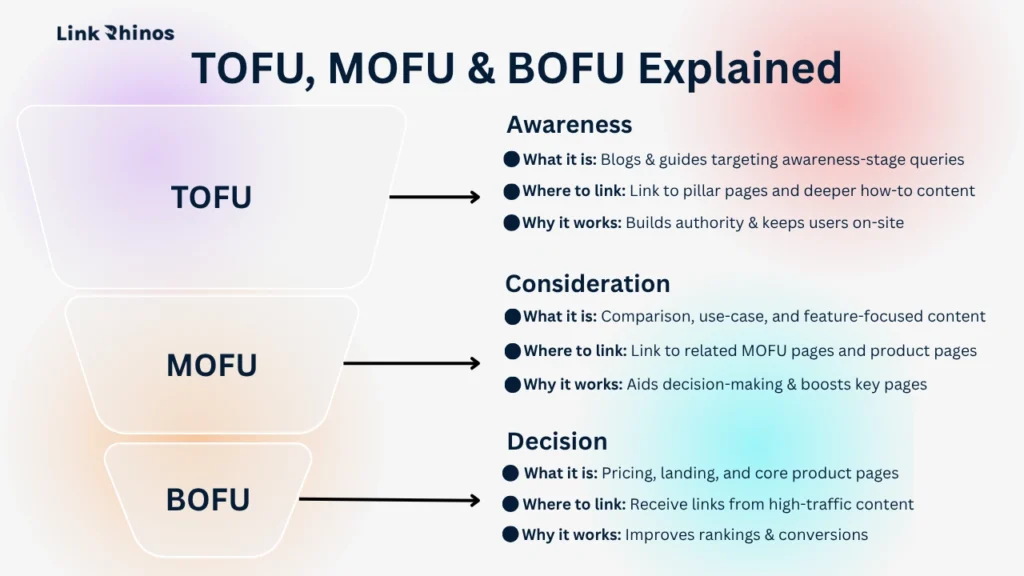
Because “link related content” isn’t a strategy – intent is what moves readers forward.
Most internal linking guides tell you to “link related content.” That’s necessary but not enough. Related by topic isn’t the same as related by intent – and intent is what moves readers forward.
Link by funnel stage instead. A reader on a top-of-funnel post isn’t ready for your pricing page. The right next step is a page that helps them go deeper on the problem – not one that asks them to buy.
TOFU – Awareness Content
What is TOFU (TOP OF FUNNEL)?
- Blog posts, guides, and explainers targeting broad awareness keywords.
Where to Link
- Point these pages toward your pillar pages and deeper how-to guides. The goal is to build topic depth and keep readers on your site rather than bouncing back to Google.
Why It Works
- These links signal to Google that your site has more to say on the topic – and they keep readers in your ecosystem longer.
MOFU – Consideration Content
What is MOFU (MIDDLE OF FUNNEL)?
- Comparison posts, use-case pages, integration guides, and feature breakdowns.
Where to Link
- Link laterally to similar MOFU pages and downward to product or feature pages. You’re helping readers compare options and move toward a decision.
Why It Works
- These links guide readers through the middle of the funnel and distribute PageRank to commercially important pages that need it.
BOFU – Decision Content
What is BOFU (BOTTOM OF FUNNEL)?
- Pricing pages, landing pages, and core product feature pages.
Where to Link
- These pages should receive links from your highest-traffic blog posts. They rarely need to link out further.
Why It Works
- BOFU pages are your most commercially important URLs. They typically have the fewest inbound links – fixing that alone can move rankings on your most valuable pages.
A link building strategy built without this funnel logic produces traffic that doesn’t convert. Internal links are the connective tissue between content acquisition and real business action.
Anchor Text Rules That Improve SEO Rankings
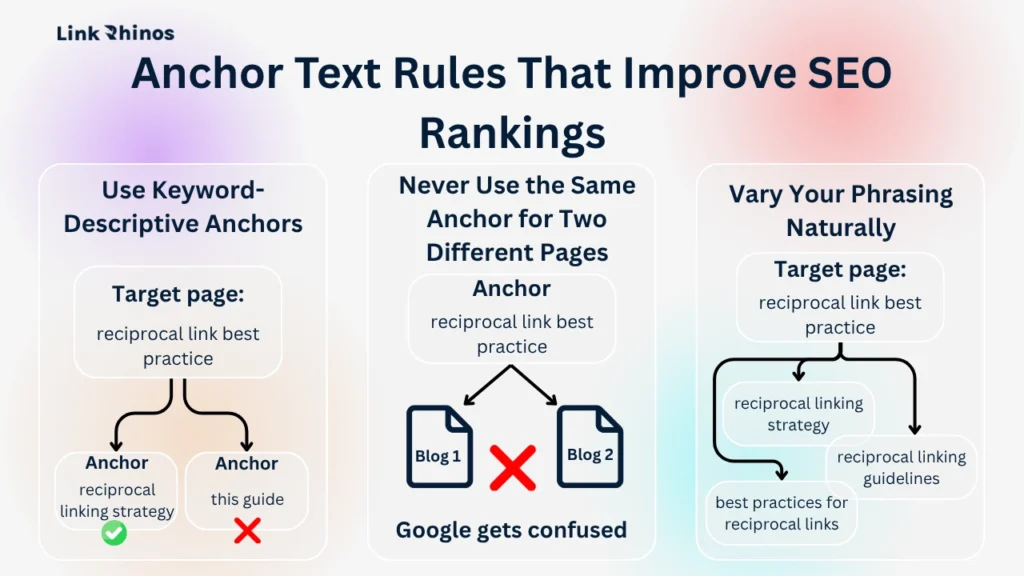
Anchor text is the most misunderstood part of any SEO internal linking strategy. Most sites default to “click here,” “read more,” or just the raw page title. Google uses anchor text as a direct relevance signal – it tells the algorithm exactly what the destination page is about. Weak anchors waste that signal entirely.
Use Keyword-Descriptive Anchors
For internal links, use exact-match or partial-match anchor text that reflects the target page’s primary keyword. If you’re linking to a post on reciprocal link best practices, the anchor “reciprocal linking strategy” does more work than “this guide” or the full post title.
Keep anchor text between 2 and 5 words. Short enough to read naturally. Specific enough to carry a relevance signal.
Never Use the Same Anchor for Two Different Pages
If you use the same anchor text to link to two different pages, Google gets confused about which page is relevant for that term. It creates topical ambiguity – and you lose the ranking benefit on both pages.
Each destination page should have its own distinct set of anchor phrases pointing to it.
Vary Your Phrasing Naturally
Don’t use identical anchor text every time you link to the same page. If every link to a given post uses the exact same phrase, it can look manipulative to Google. Instead, vary it naturally. “On-site link architecture,” “internal linking for SEO,” and “how to structure page links” all point to the same topic without looking forced.
Anchor text discipline is one of the least-discussed ranking factors – and one of the quickest to fix once you know what to look for.
How to Audit Your Internal Links in Under 60 Minutes
Once your strategy is in place, you need to check that it’s actually working. A quick audit surfaces the three problems that quietly damage most sites: orphaned pages with zero links pointing to them, pages buried at crawl depth 4 or deeper than the best internal linking strategy Google rarely visits, and over-linked nav pages that are hoarding equity your pillar pages need.
You only need one free tool to get started – Screaming Frog handles up to 500 URLs at no cost, and Google Search Console’s Links report is always available. Run a crawl, spot the gaps, and fix the five most impactful issues first. One focused session every quarter is enough to stay on top of structural drift.
For the full step-by-step process – including exactly what to look for in each tool and how to prioritise fixes – see our complete internal link audit guide.
3-Step Internal Linking Action Plan
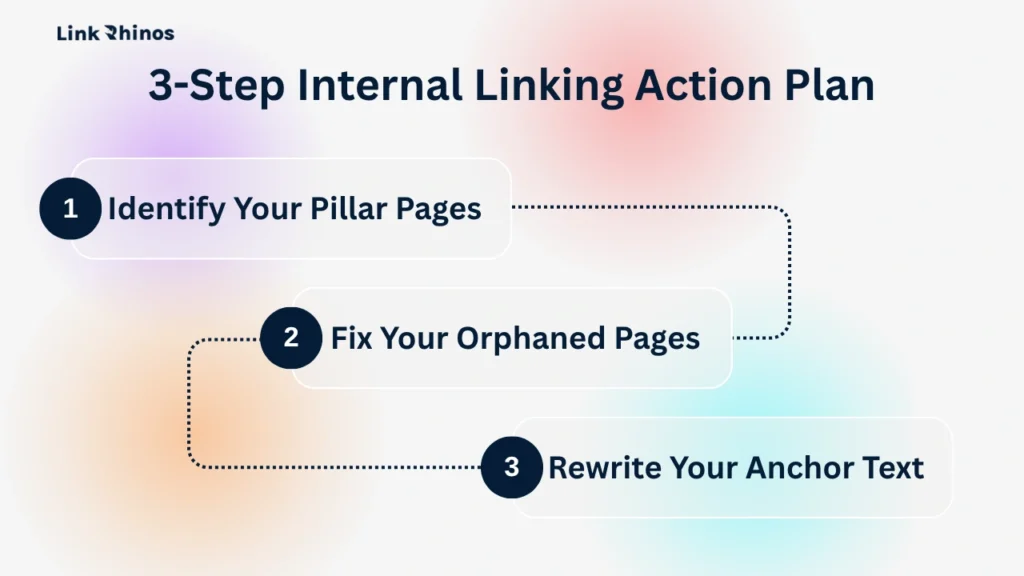
Step 1 – Identify Your Pillar Pages
Pick two or three topics that are central to your SaaS product. For each topic, designate one comprehensive page as your pillar. Every cluster post on that topic should link back to it with relevant anchor text.
If no comprehensive page exists yet, writing one is your first priority. All other linking work builds on top of it.
Step 2 – Fix Your Orphaned Pages
Run a free Screaming Frog crawl. Export all pages with zero inbound internal links. Pick the five most relevant to your pillar topics and add contextual links to each one from your top three traffic-generating posts.
This one fix alone will improve crawl coverage within a few weeks – and it costs you nothing but time.
Step 3 – Rewrite Your Anchor Text
Open your five most-linked internal destinations. Look at the anchor text of every link pointing to each one. Replace any generic anchors with 2–5 word keyword-descriptive phrases that match the target page’s topic.
This takes under an hour. It’s one of the highest-leverage on-page SEO fixes you can make without touching a single line of code.
The best internal linking strategy is one you actually implement – and these three steps are executable before the week is out.
Bottom Line
Internal linking isn’t a one-time setup task. It’s an ongoing structural decision. Sites that build pillar-cluster structures, link with intent, and audit quarterly don’t just rank individual posts better – they compound. Each new piece of content adds to the topical authority of the entire domain, not just the URL it lives on.
The sites pulling away in organic search right now aren’t necessarily publishing more than you. They’ve built a structure where every page supports every other page. That’s what a serious link building SOP looks like at the internal level – before a single external link is earned.

Your internal linking strategy and your external link profile work together – authority flows in through backlinks and gets distributed through internal links. LinkRhinos matches SaaS sites with vetted, niche-relevant backlink partners so both sides of that equation compound. No cold outreach required. → linkrhinos.com/register.